

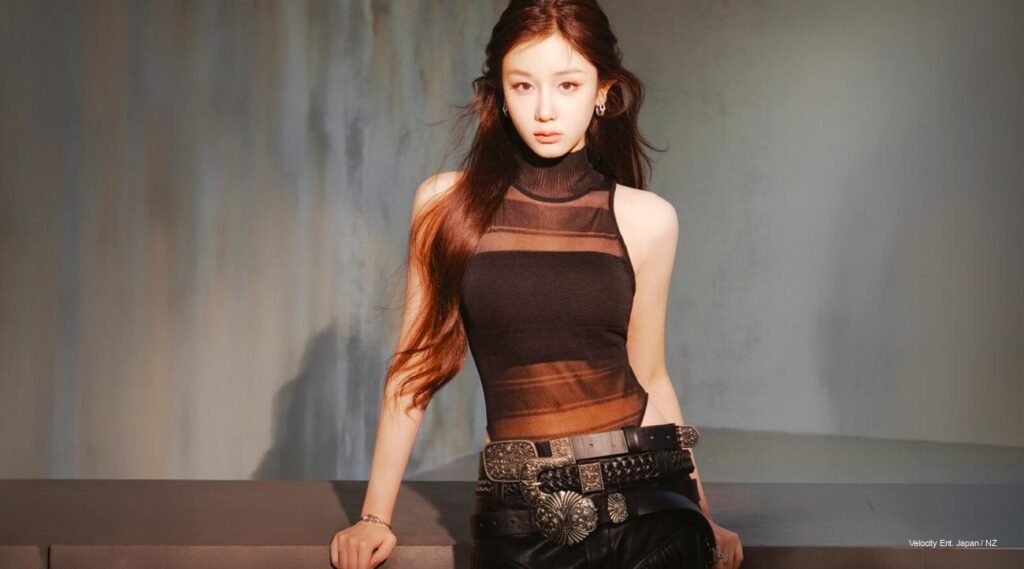
Photo Credits: Vogue Hong Kong + YG Entertainment + Balenciaga
On the cover of Vogue Hong Kong’s 2026 Anniversary March issue, BABYMONSTER stand framed in a muted, almost cinematic light, draped in Balenciaga’s Summer 2026 collection. Seven young women, only months ago still labeled “rookies,” now inhabit the center of a high‑fashion universe once reserved for supermodels and fashion royalty. The image is not just a photoshoot; it feels like a declaration—one that stitches together three threads: BABYMONSTER’s rapid evolution, Balenciaga’s avant‑garde architecture, and the global language of youth culture that K‑pop now speaks so fluently.
From YG Rookie Wave to Vogue Covers
BABYMONSTER’s journey has been less about overnight stardom than about a calculated, multi‑stage reveal. Officially introduced as YG’s next girl group in late 2022, the septet—together Ruka, Pharita, Asa, Ahyeon, Rami, Rora, and Chiquita—emerged through viral pre‑debut singles like BATTER UP and SHEESH, which bypassed the usual “waiting” phase and dropped straight into the discourse. By the time their debut era closed with Drip in 2024, the group had already converted skepticism into sold‑out shows and global streaming milestones, enough to warrant a full‑scale world tour by 2025.
In that context, the Vogue Hong Kong cover becomes a natural next chapter: less a “breakthrough” and more a confirmation of a status that fans had already written into the group’s lore. If their debut proved they could carry YG’s hip‑hop‑heavy, stage‑dominant DNA, this fashion moment proves they can carry the symbolic weight of a global luxury house.
“BABYMONSTER weren’t discovered as models—they were built as a total aesthetic universe, and now fashion is finally catching up.”
Balenciaga’s Summer 2026 as a Second Stage
Balenciaga’s Summer 2026 collection, as seen on the runway, is an exercise in architectural tension and sculptural minimalism: sharp shoulders, layered silhouettes, mesh inserts, and a palette oscillating between muted neutrals and flashes of metallics. The clothes are designed to move like a stage set, not just a wardrobe—structured coats bloom into flowing skirts, and neoprene panels lock into fluid silks, so every turn changes the light and the silhouette.
When BABYMONSTER step into these looks for Vogue Hong Kong, the collection stops being a seasonal capsule and becomes a second stage. Ruka’s elongated double‑breasted coat and Asa’s cropped, corset‑like top speak to the same rigor as their choreography: angles aligned, posture precise, tension held on a breath. Pharita’s sheer, layered dress and Rora’s monochrome tailoring echo the duality the group has always played with—innocence against edge, softness against swagger.
Fashion, here, is not decoration; it’s a narrative lens. Each member’s outfit reflects a different strand of their stage personas: the rapper, the dancer, the vocalist, the “visual” muse. Together, they form a visual ecosystem that mirrors the way BABYMONSTER’s music swings between rap‑driven aggression and melodic vulnerability.
Aesthetic Alchemy: How Visuals Shape Their Sound
BABYMONSTER’s music has always been a puzzle of influences: the dirty basslines of YG’s drill‑inspired tracks, the R&B swirl of their b‑sides, and the stadium‑ready hooks that make their choruses feel like communal chants. What’s striking is how their visual world has evolved in parallel. Early promos leaned into the “monster” side of the name—darker palettes, high‑contrast lighting, and choreography that felt like a controlled explosion.
As their sound matured through Drip and We Go Up, so did their styling. The Balenciaga‑wearing BABYMONSTER on Vogue Hong Kong are less about shock and more about presence: softer lines, more deliberate color blocking, and a focus on the way fabric interacts with light and movement. It’s the same refinement you hear in their later tracks—tighter arrangements, more atmospheric bridges, and a greater sense of control over dynamics.
In other words, the fashion doesn’t just “match” the music; it amplifies it. When they lean into Balenciaga’s monochrome severity, the effect feels like a sonic high‑pass filter on their attitude: everything extraneous falls away, leaving only power, posture, and gaze.
Fandom as a Creative Counter‑Force
Any discussion of BABYMONSTER’s Vogue Hong Kong cover is incomplete without mentioning the fanbase that helped engineer it. The March 2026 issue dropped amid a two‑year swell of grassroots campaigns branding the group as “the next fashion icons of K‑pop,” with months‑long push‑and‑pull threads predicting and dissecting every possible cover. When the Balenciaga‑heavy editorial finally arrived, the reaction was immediate: fan‑made edits, rank‑ups, and thousands of micro‑commentaries comparing each member’s look to 1990s supermodels and modern‑day runway queens.
Monstiez didn’t just celebrate the cover—they weaponized it.
Screenshots of the interview, close‑ups of the styling, and line‑by‑line breakdowns of the group’s quotes quickly populated TikTok, X, and Instagram, turning the magazine into a shared archive rather than a static artifact. In that ecosystem, BALenciaga becomes more than a brand name; it becomes a shared language, a visual shorthand for “arrival,” and a badge that fans can claim as collectively theirs.
“BABYMONSTER’s Vogue Hong Kong cover is proof that fandoms don’t just follow trends—they co‑author them.”
The Global Stage: Hong Kong, Asia, and the World Tour Effect
Hong Kong has long been a stylistic crossroads where Tokyo streetwear, Seoul’s polished glam, and Western high fashion collide. By placing BABYMONSTER on the Vogue Hong Kong cover—dressed in Balenciaga and paired with FRED jewellery—the magazine is not just highlighting a group but signaling a shift in how K‑pop figures into Asia’s luxury‑fashion landscape. BABYMONSTER’s first‑ever world tour, which wrapped just months before this issue dropped, cemented the same message: these are no longer “local” idols, but globe‑hopping performers with merch lines, VIP tiers, and set‑lists that treat each city as a different cinematic chapter.
The March 2026 cover also reads as a rejection of the notion that K‑pop fashion must always be “cute,” “candy‑floss,” or hyper‑themed.
The March 2026 cover also reads as a rejection of the notion that K‑pop fashion must always be “cute,” “candy‑floss,” or hyper‑themed. BABYMONSTER’s styling here is colder, more cerebral—cooler metallics and architectural tailoring aligned with Balenciaga’s broader design philosophy—yet it still feels unmistakably K‑pop in its emotional intensity. The eyes are sharper, the expressions more contoured, the gaze more deliberate. This is K‑pop fashion grown up, but not sanitized.
The Creative Direction: When Music, Fashion, and Image Collide
What makes the Vogue Hong Kong cover so compelling is that BABYMONSTER aren’t just “borrowing” a Balenciaga aesthetic; they’re integrating it into their own creative direction. Their music videos have already flirted with fashion‑film language—long tracking shots, sparse sets, and framing that treats each member as a moving sculpture. The Balenciaga collaboration extends that language into print, turning the editorial spread into a kind of still‑frame choreography.
This synergy is also audible. Since Drip, the group has leaned into darker, more atmospheric production, which aligns with the same palette of charcoals, muted neutrals, and metallic sheen that defines Balenciaga’s Summer 2026 collection.
When fans hear a new track, they don’t just imagine the chorus; they imagine silhouettes, fabric, light—the entire visual ecosystem that the group has built around them. In that sense, BABYMONSTER stand at a very specific inflection point: the moment when K‑pop fashion stops being a fun side‑industry and starts acting as a feedback loop to the music itself.
The Production Team
Hair Stylists: @Kimggotbi & @Eunji_ouioui
Fashion Assistants: Lee Ru Da & Kim Ye Jin
Photography Assistants: Kim Jae Min & Kim Yeo Eun & Yoo Ho Kwang
On-set Coordinators: Lee Jin Kyung & Park Mi Jeong
Wardrobe Coordinator: @T.206