

Surely Tomorrow: Episodes 11-12 (Final)
by Dramaddictally
Surely Tomorrow goes out with less energy than it came in on, giving us a conclusion that only semi-satisfies. While our heroine has gone through major changes, leading to better times between our leads, her counterpart is already too good of a guy to need much growth.
EPISODES 11-12
I like this story. I stand by it. But the jammed-in melodrama did it a disservice in its final stretch. We started with a picture of people who were hurt — mostly from their own inner demons and the outcomes those demons had on their actions — and we end with people pushed around by external circumstances. How did these characters some so far? Or, rather, how did their central conflict change so much?
We’ve been following a lackluster side story the whole way through, about Ji-yeon’s worsening dementia and Min-woo’s goal to sell Jarim out from under her, and in this last leg, the drama goes whole hog into that plotline. Last week, we got a preview of Min-woo’s idea to screw over Ji-woo by making it seem like she and Gyung-do had an affair while Ji-woo was married. And this week, he follows through.
An article comes out alleging that Ji-woo and Gyung-do have been involved for some time, creating an affair scandal, but worse, since they publicly denied their involvement earlier, it also looks like they lied. This hits our leads hard, especially Ji-woo, who feels like she can’t catch a break. She’s finally feeling better about herself and her life, and now this.
Gyung-do understands how much the news is affecting Ji-woo, but he tells her to just ignore it for now while he cooks up a plan. His boss (who’s now wholly on the side of him and Ji-woo as a couple) wants to release a rebuttal. But Gyung-do doesn’t think the truth will be good enough for people to believe. Though they’ve already denied their relationship, the public is against Ji-woo and Jarim stock prices start to fall.
Meanwhile, since it’s obvious that Min-woo is behind the scandal, he and Ji-yeon can’t pretend to be cordial anymore. They each know the other’s stakes in the long game they’ve been playing, and Ji-yeon serves him divorce papers — although he’s not willing to accept them. Instead, at a board meeting where there’s pressure for Ji-woo to resign so the company can recover, Min-woo declares that he, Ji-woo, and Ji-yeon should all resign, since the owner’s family is at fault.
All of this upsets Gyung-do even more, as he sees Ji-woo’s job and reputation both at risk. He decides to dig deeper into finding evidence against Min-woo, to prove he was drugging his wife, since the secretary that was tasked with dosing her coffee has gone into hiding. At this point, Gyung-do and Ji-woo are struggling, but not with each other. Each wants to protect the other and our heroine has no thoughts of running away this time.
But Gyung-do — as always willing to give up everything for Ji-woo — decides to take his protection a step further, without discussing it with Ji-woo first. As it turns out, there’s a backstory to his father’s accident and it involves Jarim (of course). He discloses the full story to a junior colleague at his newspaper, but it means he and Ji-woo will have to part.
The story is that Gyung-do’s dad was hurt while working construction and a couple of other workers were injured as well. However, when the settlements came, Gyung-do’s dad got a much larger one than the other guys. Gyung-do learned years later that this was because Ji-woo’s father had made sure he was compensated enough to start over, which is how Gyung-do’s parents opened their laundry business.
The article that gets released tells this story, along with Gyung-do’s reaction to learning what Jarim’s owner did for his family. He expresses gratitude and says he bought a new Jarim suit every year for the following four years in order to pay tribute to the owner. The article also states that Ji-woo doesn’t know about any of this. That, we come to learn, is only partly true. The reality is that when Ji-woo took off all those years ago without notifying Gyung-do, she asked her father to protect him — and the compensation money was how her father fulfilled her wish.
The good news is that when this heartwarming story is released, the public goes gaga for it and Jarim’s management is no longer at risk of losing their jobs — they’re heroes now with full public support, which means Jarim won’t be sold. The bad news is that it means that Gyung-do and Ji-woo can’t have anything to do with each other because Gyung-do is again denying their relationship. He justifies this by saying that he doesn’t want Ji-woo to be seen as an adulterer for the rest of her life, and so, this is what he’ll do to stop it.
And how does he let Ji-woo know about this one-sided move? Before the article goes live, he has her meet him in a field that holds beautiful memories for them both and then steps away from her when she approaches. She understands that he must be leaving her and begins to plead. True to character, she takes it on herself, saying that if she starts drinking again or messes up her life, then he’ll have to stay — as if he’s leaving because she no longer needs to be taken care of.
Gyung-do starts by saying that all he thinks about is her, and he can’t imagine how he’ll go on without her. Both of them are sobbing, standing at a distance, not wanting what’s happening, and yet, each acts as if it’s inevitable. At this point, Ji-woo doesn’t even know about the article or its content — and we don’t have the full story either — which makes it all the more confusing.
And so, they’re broken up again, but this time they still live in the same city, which makes it even tougher. Gyung-do throws himself into his work, researching the case against Min-woo to expose his crimes. And Ji-woo tries to work but is constantly distracted by trying to “accidentally” run into Gyung-do either at his office or his parents’ business. She doesn’t succeed because Gyung-do is actively avoiding her.
Gyung-do and his investigative team gather the evidence against Min-woo and it’s a done deal. The next thing we know, Min-woo is behind bars and his office is being cleared out by prosecutors. And that’s a wrap on Min-woo, Ji-yeon, and their whole story (which only existed to serve the leads’ relationship).
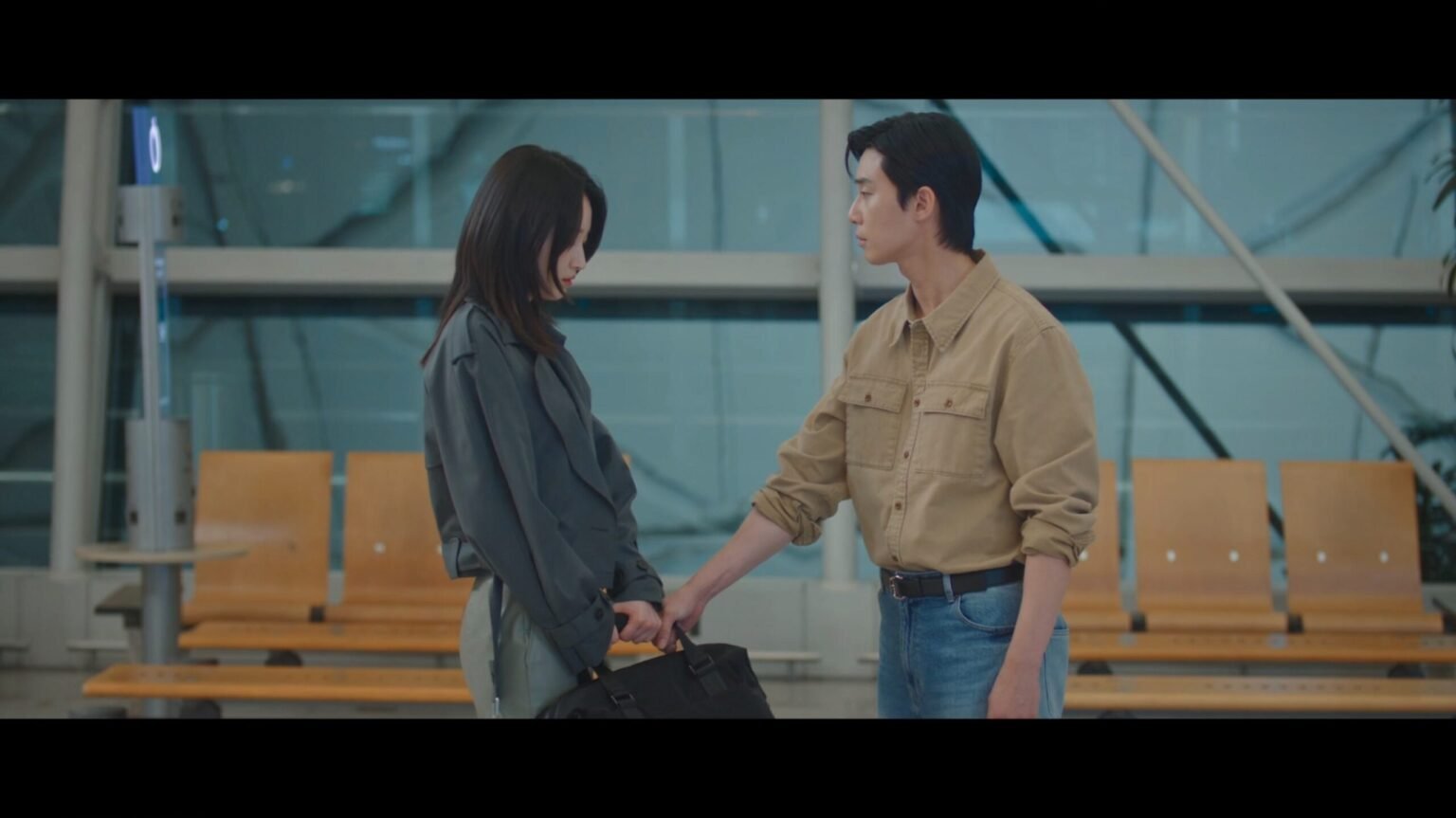
Once that’s over, Gyung-do is mostly moping around and his parents give him some money and tell him to hit the road for a while. He was supposed to go study in Chicago, why doesn’t he do that now? They know it’s hard to be so close to Ji-woo and have to avoid her, and so, Gyung-do finally agrees to go abroad for a year and travel around. He contacts Ji-woo to tell her he’s leaving, and she doesn’t try to stop him. In fact, she sees him off at the airport, smiling brightly until he’s out of sight so she can cry by herself (this is definitely a new Ji-woo compared to the one we met at the beginning).
A year goes by and Ji-woo continues to be successful at work while waiting for Gyung-do (and the drama’s nods to Godot appear to be no more than a cute play on words). She doesn’t contact him because when he left, he made it clear that he needed to get over her. He wanted to be able to feel happy when he sees her, not sad that they’re not together.
We see him in Málaga, working at the accommodation where he and Ji-woo once stayed, while also scooping ice cream on the side. Although Ji-woo travels to Spain for business and takes a few days in Málaga to revisit their shared sites, she doesn’t run into Gyung-do.
The two are reunited when a close mutual friend dies in a fire and Gyung-do flies back to Korea to attend the funeral. He had once told Ji-woo in an early episode, “I’ll see you at the funeral,” and now the story brings it back around to make it true — although neither of our leads have died, which was what Gyung-do had spitefully meant.
Following the services, Gyung-do and Ji-woo speak, realizing they’ve both gotten to see the other’s perspective in their time apart. He sees how hard it is to be the one who leaves, and she sees how hollow life becomes when you’re the one left behind. Still, Gyung-do plans to get right back on a plane, and Ji-woo is tormented over whether or not to try to stop him.
In the end, she rushes to the airport and tells him to stay, confessing that he’s the only one for her and she’d rather be called an adulterer than be apart. He responds, “Let’s go home.” And we hear that this time, it’s their time.
Let me tell you the things I love about this story. First, we’ve got two characters who are amazing together — who are truly happier and better people when they’re together — and whose only problem is that one of them is too insecure to let the relationship happen. This setup was done right, with Ji-woo being believable as a wounded woman with a charming tough-girl act.
Then, we get to watch how the couple’s dynamic shifts according to the whims of her moods. When she’s happy, they’re happy. And when she can’t stand herself, she acts in hurtful ways. But each time that she comes back and lets things be easy, there are no grudges between them. They live in the present, without defensiveness (maybe a little naively since they both keep getting hurt), until the time when Ji-woo comes around and makes lasting change.
That incremental growth, both for Ji-woo and on the part of the relationship, was really lovely to watch. It’s sometimes vague, with a lot left unsaid, but that made it feel all the more authentic. And this occurs in the context of two other things I loved: an old-school reporter who gets his hands dirty digging into the case — ready to reveal the truth at all costs — and a character who’s resolutely on the wagon. It’s rare, in my viewing, to see alcohol dealt with in this matter-of-fact way that’s not about cultural norms, but about how drinking can sometimes take a long-lasting and destructive toll.
Outside the central dynamic of the leads, everything else falls flat. The stuff surrounding Jarim, Ji-yeon’s illness, and even the theater friends all exist to serve plot points, rather than existing on their own. It’s a world held up with people as props, allowing us to see the stitched seams of the story. Essentially, there’s forced separation because it’s a dramatic trope, not because this narrative needed it. In fact, it takes away from the heart of what’s already here.
But my bigger issue is with Gyung-do, who’s resolutely a good guy from start to finish (gotta love him), and who doesn’t get to experience the same kind of internal shift that Ji-woo does. It’s true that they get to switch perspectives, and that she has to wait for him instead of the other way around, but that’s still about Ji-woo’s growth, not his. Gyung-do plays the hero, yet again, making sacrifices for her like he always did, which I’m not convinced is a good thing.
Their internal struggles are what made this story stick, and the external kicks they receive don’t result in the same emotion, throwing off at least the last two episodes. But that’s not to say the actors didn’t react with the same emotion. In fact, the dialogue between Ji-woo and Gyung-do is the spine of this story, and in these last episodes, their crying scenes are brutal (was Park Seo-joon always such a good cryer?). Had the drama rested on that strength all the way through, this could have been even more affecting.
Still, if I’ve learned anything from these once-broken characters, it’s to take heart in the present and stay hopeful for the future. If this drama wasn’t perfect — despite its well-developed couple — we can always keep waiting. Another great one will come along, maybe — no surely — tomorrow.
RELATED POSTS