

X
The dress arrives before the music does.
That is the only way to describe the moment Maya steps into frame in the “Gala” visual — a high-saturated electric blue silhouette by Chinese designer Sensen Lii of Windowsen, its structure somewhere between a collapsed skyscraper and a deflated dream.
The garment is not decoration. It is an argument. And before a note has played, XG has already won it.This is the group’s method: aesthetics as aggression.
Fashion as the first word in a language that has no name yet — not K-pop, not J-pop, not Western R&B. They call it X-POP. The industry calls it a category problem. The culture calls it inevitable.
Seven Japanese women who do not ask for the room — they rearrange it. XG is not the future of K-pop. K-pop is one country they passed through. – By the Editors of Rolling Stone Japan
CHROME BLOOD – Identity Through Fashion
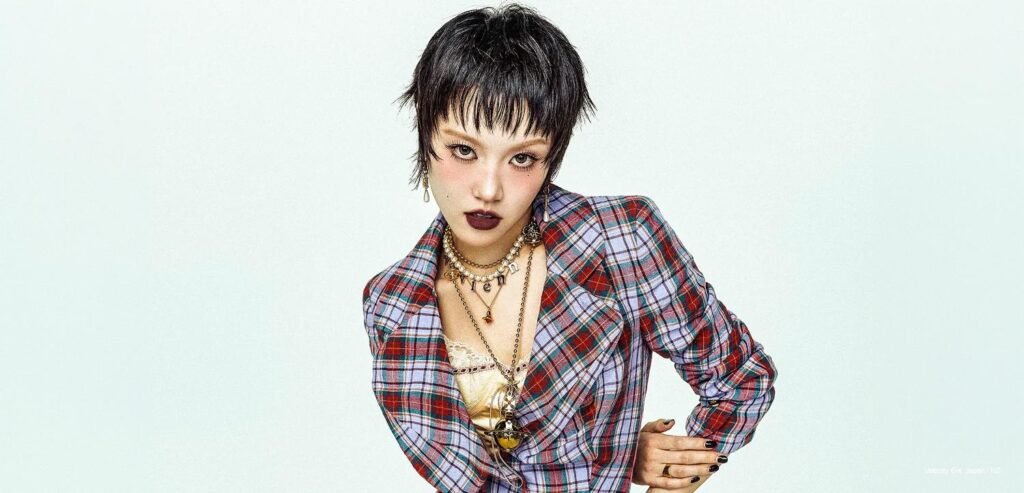
Long before XG’s debut album The Core — 核 dropped in January 2026 and cracked the U.S. Billboard 200, before the group became the first Japanese act to headline the main stage at Coachella, before “The Core” world tour sold out venues across three continents — there were the clothes.
XG and Windowsen are not a brand partnership. They are co-authors of a vision. At Coachella 2025, the entire group stepped out in custom Windowsen: exaggerated silhouettes, metallic fabrications that catch desert light like crumpled foil, and the quietly extraordinary move of heat-transferring member Chisa’s face onto a garment’s surface. The body becomes the artwork. The artwork wears the body. The boundary dissolves.
We are not dressing for the stage. We are dressing for a world that doesn’t exist yet — and then building it.
— XG, on their relationship with fashion and world-building
The aesthetic through-line is Y3K: not the saccharine nostalgia of Y2K revisionism, but something colder, more deliberate. Acid greens, chrome silvers, electric blues.
Chunky accessories that read as armor. Exaggerated geometry that treats the human form as architecture. This is fashion as a statement of temporal dislocation — XG are not here, now, in 2026. They are transmissions from a decade that hasn’t arrived yet.
The styling vocabulary extends beyond Windowsen: metallic corsets over structured suiting; asymmetrical cutouts that reference Demna-era Balenciaga without genuflecting to it; streetwear underlayers that anchor the maximalism in something bodied and real. Every look in XG’s visual archive is legible as both couture provocation and functional performance wear. They never sacrifice function for drama. They insist on both.
Fashion Profile · Windowsen × XG
THE ALIEN COUTURE AXIS
Designer Sensen Lii’s Windowsen label — named for Microsoft’s Windows OS, built on a sci-fi imagination that pushes fashion into the alien-esque — has found in XG its ideal canvas. Custom Coachella looks. The “Gala” MV wardrobe. An ongoing dialogue between a group who dress as if gravity is optional and a designer who agrees. Together, they have defined Y3K fashion’s foremost visual vocabulary.
SONIC ARCHITECTURE
The Core — 核 is, among other things, a fashion document in audio form. Hip-hop, R&B, dance, and psychedelic pop compressed into a 29-minute album that behaves like a tailored suit: structured at the shoulder, fluid at the hem, with something unexpected in the lining. Singles “Gala,” “4 Seasons,” and “Hypnotize” are not songs so much as aesthetic position statements — each a different texture of confidence.
“Woke Up,” from the 2024 EP Awe, marked the moment XG made the violence of their ambition fully legible. An all-rap track in which the group describe themselves as a wolf pack, it arrived alongside a music video in which Cocona boldly shaves her head — an act that in idol culture carries the weight of a manifesto. The visual is inseparable from the sonic. The hair hits the floor and you feel the bass drop a second later, even if there isn’t one.
Producer Simon Jakops built this group over five years of training beginning in 2017, through the Avex Artist Academy in Tokyo. What emerged was seven women who sing exclusively in English, move between linguistic registers without accent anxiety, and treat the three-language fluency — Japanese, Korean, English — not as a commercial calculation but as a lived state of being. The music sounds like that. Borderless. Slightly vertiginous. Completely deliberate.
X-POP is not a genre. It is a refusal — of limits, of categories, of the idea that origin determines ceiling. — Rolling Stone Japan editorial analysis
IMAGE CONTROL
What separates XG from their contemporaries is not just aesthetic calibration — it is the unsettling clarity of their intentionality. In an industry built on the management of image, XG appear to be the rare case where the group and the image are not in negotiation. They are the same thing.
The Coming of Age announcement in January 2026 — all seven members simultaneously turning twenty — was handled not as a corporate press release but as a creative declaration, tied to the release of The Core and the launch of their second world tour. Every milestone in XG’s chronology arrives dressed. Nothing is incidental. Chaos, when it appears, is choreographed. Rebellion, when it surfaces — in a shaved head, in an all-rap album that rejects melody as too easy — is precision-engineered. This is the group’s central paradox, and it is an entirely modern one: the most controlled performers are the ones who read as most free.
Their relationship with Riot Games in April 2024, the Billboard Hot Trending Songs #1 position (the first Japanese act to hold it), the Coachella main stage in 2025 — these are not accidents of virality. They are the inevitable outcomes of a group who understood, from their first digital single “Tippy Toes” in 2022, that in the attention economy, taste is infrastructure.
ALPHAS AS ARCHIVE
The ALPHAZ — XG’s fandom, the name a counterpart to the group’s wolf-pack mythology — are not passive consumers of a brand. They are active participants in a visual language. The way ALPHAZ decode and reproduce XG’s aesthetic choices, from the Y3K styling cues to the structural silhouettes, constitutes one of the more interesting fashion feedback loops operating in pop culture today.
XG concert footage, particularly from “The First Howl” world tour (May 2024 to May 2025), reads less like idol concert documentation and more like a fashion week front-row archive. The audience dresses to compete with the stage. Metallic fabrics, face gems, exaggerated accessories — the Y3K aesthetic has migrated from XGALX’s creative direction into the wardrobes of teenagers in Seoul, Tokyo, New York, and São Paulo.
This is the quiet cultural export that fashion critics haven’t fully accounted for: K-pop’s second-generation acts are not just selling merchandise. They are transmitting visual codes that restructure how entire demographics dress themselves.
They don’t have fans. They have co-conspirators — people who understood the assignment before it was explained. — Rolling Stone Japan, on the ALPHAZ fandom ecosystem
THE DISRUPTION
The honest conversation about K-pop and the global fashion ecosystem is still mostly being had around its edges. The industry knows that when groups like XG partner with luxury houses or independent designers, the commercial velocity is extraordinary — but the critical infrastructure to properly assess what that means for fashion’s own hierarchies remains underdeveloped. A Japanese group operating through the K-pop production system, releasing exclusively English-language music, headlining American music festivals, and anchoring an entire aesthetic subculture: the genre labels keep failing.
That failure is XG’s greatest asset. The group’s position outside every obvious category means they can colonize all of them — and have. The Core world tour, now mid-run as this issue publishes, is not a K-pop tour in any meaningful sense.
It is a global pop spectacle with fashion at its center, running through arenas in Asia, Europe, and North America. The staging aesthetics — minimal, architectural, light-heavy — read as more Raf Simons runway than idol concert. The styling credits matter as much as the setlist.
The tension between commerce and artistry that haunts most conversations about idol culture finds a different shape in XG’s case. XGALX’s production model is clearly industrial in its precision. Five years of training, multi-language fluency, an image system that never relaxes. And yet the creative output consistently exceeds what pure commercial logic would produce. Cocona doesn’t shave her head because a marketing team green-lit it. Maya doesn’t stand in an avant-garde electric blue architectural dress because a stylist reached for the safe choice. Something is being made here that is not reducible to its machinery. That gap — between the system that built them and the thing they have become — is exactly where interesting art always lives.
XG are, at this moment in 2026, the clearest signal of where youth identity, global pop, and fashion’s relationship with music are heading simultaneously. Not K-pop’s future. Not J-pop’s answer. Not Western pop’s newest import. Something that sits in the orbital space between all three and transmits a frequency that every antenna is already, whether it knows it or not, tuned to receive.
The dress arrives before the music does. And then the music arrives, and you realize the dress was only the opening argument.
こちらからフィードバックがありますか?こちらからお知らせください。日本語でも大丈夫です。
피드백이 있으신가요? 여기에서 알려주세요. 한국어도 가능합니다.
Published By Kpoppie Magazine – Velocity Entertainment Inc.- Japan · New Zealand
Issue Rolling Stone Japan – Digital Exclusive · Vol. XLII · May 2026
Cover: XG — “The Signal”
Editorial Credits – Cover Story – Rolling Stone Japan Editorial Team
Fashion Direction – XGALX Creative Division
Wardrobe – Windowsen (Sensen Lii)
Copy Edit – Rolling Stone Japan Desk
Rights & Permissions
© 2026 Kpoppie Magazine. Published by Velocity Entertainment Inc. (Japan / New Zealand). All rights reserved. No part of this publication may be reproduced, distributed, or transmitted in any form or by any means — including photocopying, recording, or other electronic or mechanical methods — without the prior written permission of the publisher, except in the case of brief quotations embodied in critical reviews and certain other non-commercial uses permitted by copyright law.
Rolling Stone® is a registered trademark of Penske Media Corporation. Rolling Stone Japan is published under exclusive license. All editorial content, photography direction, and design © 2026 Kpoppie Magazine / Velocity Entertainment Inc.
XG, ALPHAZ, XGALX, and X-POP are trademarks of XGALX Inc. / Avex Group. All artist references used for editorial and journalistic purposes only.
Kpoppie Magazine · Velocity Entertainment Inc. · Japan / New Zealand