

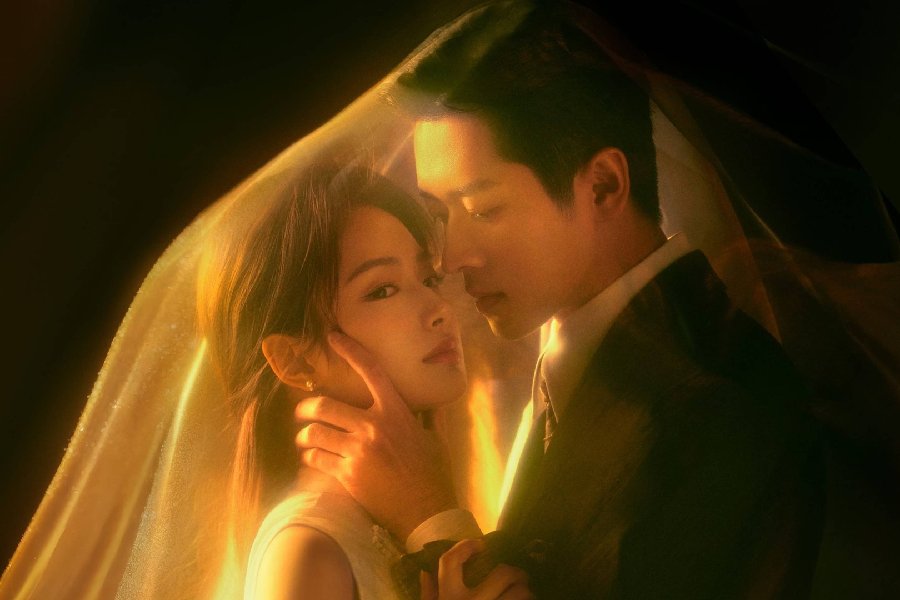
Set against the volatility of Republican-era China in the early 1920s, “The Lament of Autumn” weaves a complex tale of desire where ruthless warlords and shrewd tycoons forge powerful alliances in their quest for power. In this world, relationships serve military and business interests over love, and the need to control and dictate even reaches the personal.
Yu Chang Xuan (Ryan Cheng) is the fifth son of the highly influential Yu family, military commanders in charge of Nanhuai City. Chang Xuan is intelligent and discerning, and his dashing good looks have made him the catch among women, but his reputation as a playboy precedes him. The man doesn’t care for social niceties; if he wants something, he gets it—until he meets Ye Ping Jun (Xu Ruo Han). Ping Jun is a brilliant student who comes from an ordinary home. She takes on odd jobs to help pay for her mother’s medical bills. Proud and resilient, she stands for equality for all, irrespective of social standing. Ping Jun unwittingly gets caught up in an assassination bid against Chang Xuan. This one incident changes the course of their lives, as she becomes the object of Chang Xuan’s obsession. What ensues is a psychological battle where cold schemes give way to forbidden desire and a dynamic that’s all too consuming.
“The Lament of Autumn” has had viewers hooked so far, and if you haven’t started watching it yet, here are three reasons why you must.
Warning: spoilers ahead!
Cheng Lei as the ruthless Chang Xuan
Chang Xuan’s gorgeous good looks and cocky attitude strike you immediately at first glance. The man is self-assured and unperturbed by everything around him. His mocking smirk, accompanied by his cool stare, makes him irresistible and even detestable at times. He is a man you hate to love and love to hate.
His father, the powerful General Yu Zhong Xuan, feels Chang Xuan is nothing but a troublemaker in comparison to his eldest son, Yu Ming Xuan, who died in battle. His father’s affinity towards his elder brother, and the memory of how Chang Xuan survived despite being left to die in the same battle, continues to haunt him. Chang Xuan, well aware of the corruption in the military and the power nexus between the wealthy and military generals, wants to secure his own position in the military. But he is constantly denied by his father, being dismissed as a womanizer and a man with no grounding in life.
Chang Xuan, in his own calculated ways, intercepts strategies and alliances. When he saves his father from an assassination bid, he strikes a deal: he should be given power and control of the Nine Corp, claiming his brother’s legacy and securing his own position as the leader of the family’s forces.
The man plays the same card in his personal relationships. He patronizes an opera singer who performs at the Xiangxi Hotel, which he owns. On the other hand, he is on and off with the rich and haughty Tao Zi Yi (Gao Yu Xin), a woman he just indulges for his own selfish motives. Chang Xuan believes that the end justifies the means. He is unscrupulous and is a man who plays and punishes by his own rules.
But things change when he meets Ping Jun. He hates her guts but is strongly attracted to her. She is a woman with pride. Even when he makes her sign a contract to catch the main culprit in the assassination investigation, he manipulates it to secure her employment at the hotel. It’s his way of controlling her, but she defies him every single time. This further fuels his fascination for her, to the point that he is consumed. He is a cruel savior; he pushes her to the limit but also stands as a protective barrier, shielding her from attacks that come her way.
Chang Xuan is a complex and layered man who, at most times, is incomprehensible. He masks his humanity with irreverence, as in the moment when he takes care of refugees, tending and playing with the little children. It gives him a softness which he quickly conceals. When Ping Jun apologizes to him for calling him a cold-blooded tyrant during the refugee crisis, his response is a clipped, “Don’t try making me a saint. I won’t be able to take it.”
Ryan Cheng articulates the contradictions of his character with élan. The actor’s tremendous screen presence, accompanied by his contained intensity and understated magnetism, makes Chang Xuan a character who is pulsating and dynamic.
Murky emotional dynamics between characters
If you are expecting a sizzling forbidden romance against the turbulent era of Republican China, “The Lament of Autumn” is not that show. It defies almost every trope in the book. What unfolds instead is a complex, deeply dysfunctional relationship between the leads, driven by psychology, need, and transaction. Chang Xuan takes a sadistic pleasure in watching and tormenting Ping Jun, showing no mercy. Whether it is his own water drowning inquisition or when she is being targeted by Tao Zi Yi on every possible occasion, he revels in seeing her struggle. But there is also begrudging respect for her resilience. His response to his closest friends is, “I want to see how far she can hold out.”
There is no denying that Chang Xuan is swayed by the presence of Ping Jun. He first thinks it’s just desire but later realizes it has consumed him far more. Aware that her social standing doesn’t merit her a place in his life, he orchestrates situations. When Ping Jun is adopted as a sister of the Bo Ren family, he is close to her; it is a way of securing her position beside him. He makes sure she is employed at the hotel and is helping the dance troupe with their scripts—it’s his way of having her in his domain. And he coerces her into being his date at his birthday dinner, the condition for it being terminating what she describes as a suffocating work contract. And it’s to tell those around him that she is his woman.
But Ping Jun refuses to be cowed down by him and his ways. She hates his presence and loses no opportunity to mock him, and he indulges her. There is a ferocity and a fondness, which confuses her as well everyone else around him.
He announces his engagement to Tao Zi Yi with the agenda of gaining access to the funds of her father, an influential banker. Yet he is overcome by jealousy when he learns Ping Jun has a fiancé, Xue Ting (Liu Dong Qin). He recruits Xue Ting to a secretary position in the Nine Corp, and it’s yet another way of having Ping Jun within his radar. He wants to keep her by his side, whatever it takes. The line between lover and tormentor is never clear, but his coercive attachment to her runs deep.
Ping Jun is no damsel in distress either. A woman with strong ideals and beliefs, she stands for the truth but is naive when it comes to the dangerous power play around her. Her mother is hiding a secret so as to protect Ping Jun. On the other hand, Xue Ting, who has returned after four years in Japan, does not seem entirely forthright about his mission. He is a dodgy man with his own agenda, but Ping Jun trusts and believes anything he says. And on top of it all, she keeps getting entangled and sucked into Chang Xuan’s world, which creates a paradoxical dependence. There is an uneasy symbiosis between the characters, where there are no clear moral absolutes since neither is entirely right or wrong.
The chemistry between the two is also tense, one that is charged with antagonism, desire, and distrust. She is the tragic heroine; he is the savior. But can these two even find a way towards each other among the chaos?
A turbulent era with stunning style
The setting of this show is as much a reason to watch as the leads. The early 1920s were a volatile time in China. The Qing dynasty had fallen, the young Republic was fractured, and ruthless warlords carved the country into rival territories where power rested on alliances of convenience. Yet the same unsettled decade was also thriving culturally, with the New Culture Movement questioning tradition and championing science and democracy. It is this world that shapes Ping Jun, a student who stands for equality irrespective of social standing. And while Chang Xuan is aware of the systemic abuse, he wants to seize power and create a system which can replace the lawlessness.
And then there is the fashion, which you simply can’t take your eyes off of. The cheongsam, the body-skimming dress that Shanghai made famous in the 1920s, is a statement in itself. In the early Republic, wearing it was seen as a quiet nod to gender equality, and by the end of the decade, it had picked up a distinct flapper flair borrowed from the West. Ping Jun’s simple cheongsams carry that spirit—modest on the surface but thoroughly modern. The upper class, by contrast, is all satins and chiffons, as seen in the clothes worn by Zi Yi and the Yun women, who are adorned with glittering jewelry and sleek short hairstyles topped with hats. The men in “maguas” (shirt-length Mandarin jackets), Zhongshan tunic suits, and military uniforms with stiff stand-up collars and decorative epaulettes also look sharp and striking. Every costume tells you where a character stands. The result is a world that is colorful and pulsating and a reminder that even in turbulent times, this was an era that dressed to be seen.
Start watching “The Lament of Autumn”:
Watch Now
Puja Talwar is a Soompi writer with a strong Jing Bo Ran and Lee Junho bias. A long time K-drama fan, she loves devising alternate scenarios to the narratives. She has interviewed Lee Min Ho, Gong Yoo, Cha Eun Woo, and Ji Chang Wook to name a few. You can follow her at @puja_talwar7 on Instagram.