

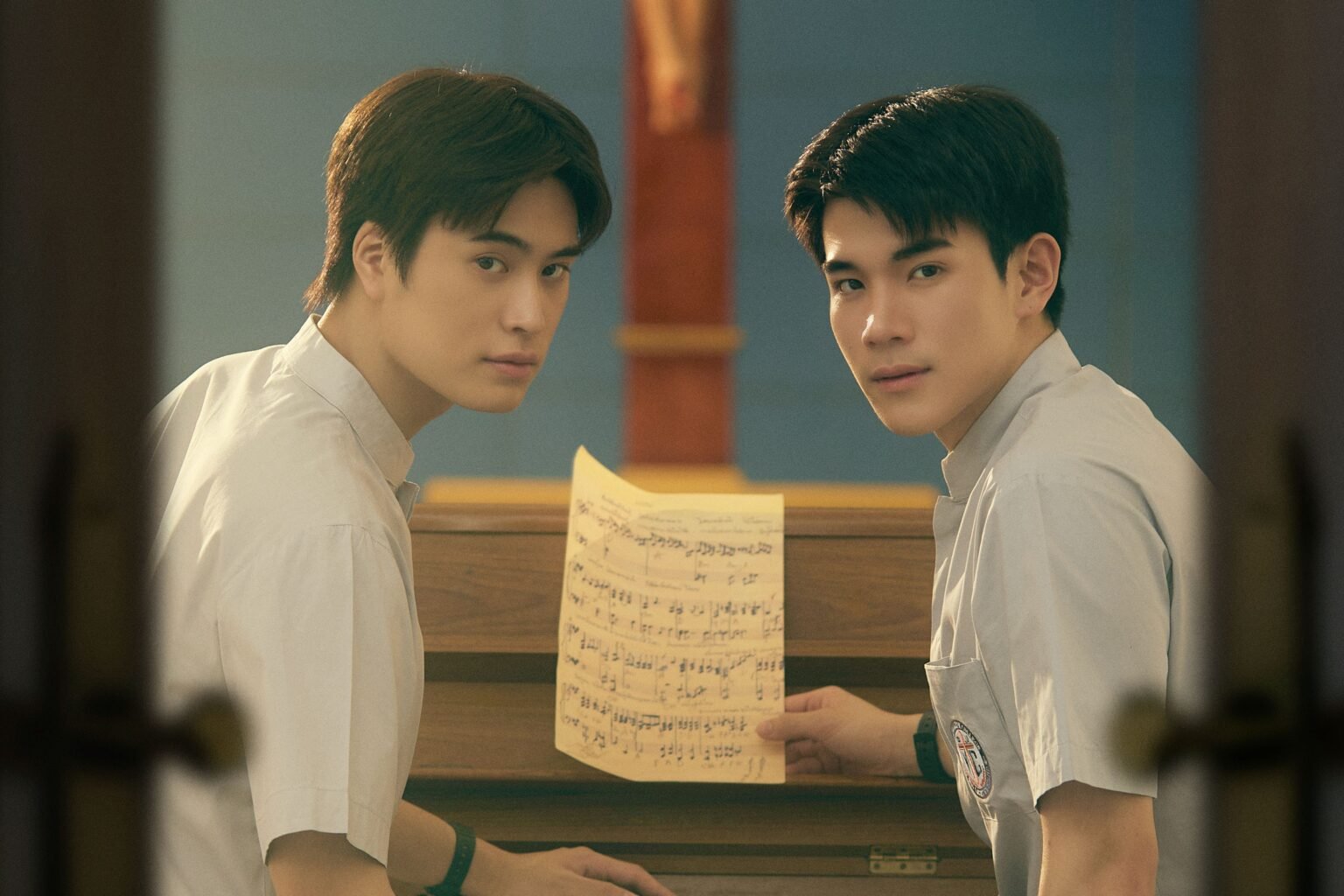
What happens when the person who makes you question everything you believe in also becomes the person you cannot imagine living without?
In “Ticket to Heaven,” Tanrak (Fourth Nattawat Jirochtikul) has dedicated his life to the church, hoping that a future as a priest will eventually reunite him with the parents he lost as a child. But his carefully planned life is disrupted when Barth (Gemini Norawit Titicharoenrak), a rebellious new student, arrives at the seminary. Tasked with guiding Barth, Tanrak soon finds himself confronting feelings that challenge everything he has been taught about faith, love, and salvation.
Here are four reasons to watch Fourth and Gemini’s new Thai BL “Ticket to Heaven.”
Disclaimer: This feature is not intended to offend or pass judgment on any beliefs, religions, or individuals.
Warning: spoilers ahead.
A gripping start with impending doom
“Ticket to Heaven” is technically set in the present day. The drama opens with Barth driving to a church as the radio announces that the country’s marriage equality law has been reinforced since January 22, 2025. While the sunlit scene initially appears hopeful for the future of LGBTQ+ individuals in the country, the unreadable expression on Barth’s face makes the audience wonder why the news does not seem to affect him.
After reaching the church, the audience’s curiosity turns into slight concern when Barth tells the pastor that he could not have missed coming to the church that day because someone very important to him is being ordained. This immediately raises the question: Is the “important person” Tanrak? If so, that would mean Barth and Tanrak never got the chance to be together.
The drama begins with this sense of impending doom, which adds weight to every scene set in the 1990s as the story explores Barth and Tanrak’s youth. Every time Tanrak hesitates or takes a step back over the course of the six episodes, the audience can feel the same sting in their hearts that Barth feels, knowing that these small moments may eventually fill the next three decades of both their lives with what-ifs and if-onlys.
The existence of religious guilt is cinematic at times
Since the story revolves around two gay men—Tanrak, a seminarian and student of religion, and Barth, a “troublemaker” who joins the same seminary—the presence of religious guilt is almost inevitable. However, the drama’s use of religious symbols to create a stark contrast between the boys’ growing feelings and the guilt that accompanies them makes many of these scenes particularly palpable. The audience can truly feel what Tanrak is experiencing.
One such scene takes place in an earlier episode, when Barth plans to sneak out of the seminary in the middle of the night to buy roti, and Tanrak helps him climb over the wall. As they find themselves in close proximity, Tanrak hesitates. At this point in the story, it has not even been established whether Tanrak acknowledges his sexuality, but the moment clearly marks the beginning of his attraction to Barth.
Later that night, Tanrak keeps replaying their interactions in his mind as choir music plays in the background. The juxtaposition of sacred music associated with the church and Tanrak fantasizing about another man, something he has been taught is a sin, is deeply impactful. This is far from the only scene in which the drama uses religious themes to highlight the boys’ attraction to each other, and the recurring symbolism enhances these moments beautifully.
“Ticket to Heaven” answers who gets the ticket to heaven
“Ticket to Heaven” takes its title from an in-story painting of the same name. The painting depicts a man climbing a staircase toward heaven, with creatures on either side attempting to lure him away from the “right path.” If he ignores them, like the man in the painting, he will receive his “ticket to heaven.”
Many faiths often come with a set of rules that determine whether an individual will be granted eternal salvation. In “Ticket to Heaven,” Tanrak desires this ticket not simply because he wants to go to heaven, but because his parents died when he was young, and salvation guarantees that he will meet them again in the afterlife.
As a result, his guilt becomes something more personal than a simple conflict between himself and the rules of his religion. It becomes a question of whether he should choose the possibility of meeting his parents again or spend this life with Barth.
The answer to his religious guilt eventually comes in the form of his father’s old friend, a woman living a life that many people at the time might have considered sinful. Yet she appears closer to God and more filled with God’s love than many of the people who would accuse her of sin.
At this point, the question changes. It is no longer simply about salvation and damnation. Instead, the drama asks: Is God’s love so conditional that it cannot exist alongside the love shared between two human beings? Would God punish people for loving after giving them the ability to love?
It offers a window into youth despite the heavy themes
Despite dealing with heavy themes such as religious guilt and homophobia, “Ticket to Heaven” never shies away from offering a snapshot of Barth and Tanrak’s youth.
From spraying water at each other instead of cleaning the chairs to playing tic-tac-toe during class, going to waterfalls, and sneaking out of school, these moments are soft and sweet. They fill the story with warmth and remind the audience that, beneath all the religious guilt and societal expectations, Barth and Tanrak are still just two young people falling in love.
Ultimately, “Ticket to Heaven” is a must-watch for anyone looking for a deeply emotional and beautifully crafted BL drama. The intimate kisses between Barth and Tanrak are sparse, but their very scarcity makes each one feel almost sparkling. Combined with the undertone of forbidden love, every moment of intimacy feels even more exciting and meaningful. With its emotional depth, stunning symbolism, and unforgettable romance, “Ticket to Heaven” is a drama that deserves to be experienced.
Start watching “Ticket to Heaven”:
Watch Now
Javeria is a binge-watching specialist who loves devouring entire K-dramas in one sitting. Good screenwriting, beautiful cinematography, and a lack of clichés are the way to her heart. As a music fanatic, she listens to multiple artists across different genres and stans the self-producing idol group SEVENTEEN. You can talk to her on Instagram @javeriayousufs.
Currently watching: “See You at Work Tomorrow,” “Dream to You,” “Bittersweet Love,” and “Spooky in Love.”
Looking forward to: “Four Hands, Two Sonatas” and “Wednesday, Thursday, Friday”