

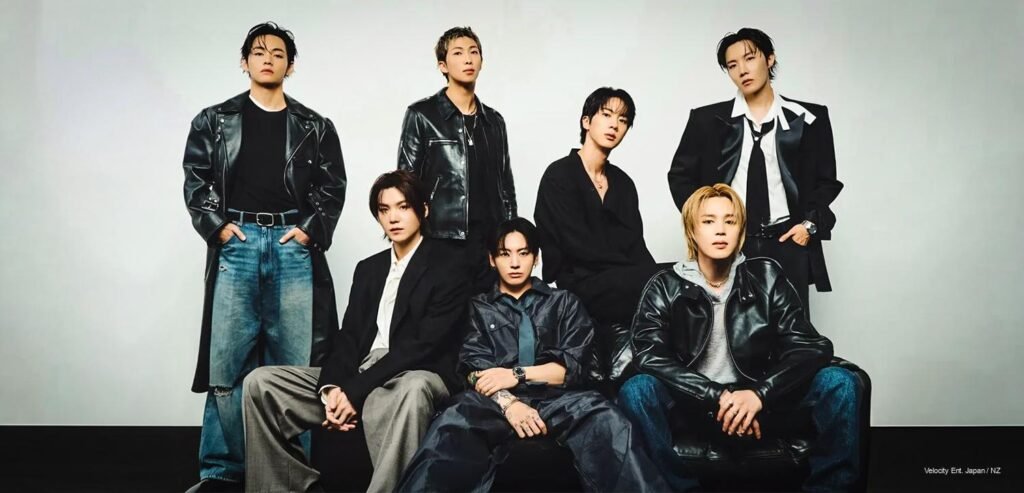
All images courtesy of Rolling Stone / © 2026 Rolling Stone LLC. All rights reserved. Photographed in Seoul, February 2026.
There is a photograph from the May 2026 Rolling Stone cover shoot that stops you cold. Seven men, each alone in their own frame, each a self-contained universe of intention. RM wears a shiny black leather jacket over oversize parachute pants, chunky boots, hair frosted at the tips — the kind of look you’d have to be a member of BTS to pull off.
Rolling Stone Across the eight covers, the wardrobe credits read like a dispatch from the new global menswear canon: Rick Owens and Ann Demeulemeester for Suga; Dior for Jimin; JUUN.J and Post Archive Faction for J-Hope; Acne Studios and Dries Van Noten for Jungkook; Maison Margiela and BONBOM for V; John Lawrence Sullivan and GOOMHEO for RM; Sonia Carrasco and Gucci for Jin. Rolling Stone It is not a K-pop stylebook. It is a master class in cross-cultural dressing — one that happens to be worn by the most-talked-about band on the planet.
BTS’s return with ARIRANG is not simply a music-industry event. It is a fashion reckoning. And the Rolling Stone shoot is its most articulate statement yet.
The Architecture of Their Aesthetic
To understand what BTS has done to global style, you need to understand what they were doing before anyone noticed. Since their earliest years, the group has operated with a fashion intelligence that goes beyond label-dropping. They have consistently chosen clothes that carry argument — garments that speak to identity, gender fluidity, cultural origin, and emotional state all at once. What the May 2026 Rolling Stone issue makes explicit is how far that argument has evolved.
Each member brings a distinct aesthetic, further amplified through high-profile ambassadorships: RM with Bottega Veneta, J-Hope with Louis Vuitton, Suga with Valentino, Jimin with Dior, V with Celine, Jungkook with Calvin Klein, and Jin with Gucci. Pretavoir These are not simply brand deals.
They are calibrated statements of individual creative identity, each member having arrived at a house that matches their particular sensibility. Jimin’s devotion to Dior speaks to a tailored, razor-precise elegance. V’s alignment with Celine reflects his commitment to minimalism that always carries a slight emotional undercurrent.
RM’s Bottega Veneta partnership makes perfect sense for a man who collects art, reads Rilke, and dresses as though clothes are a form of criticism. What unifies them, beneath the surface plurality, is a shared aesthetic intelligence the fashion world is only now fully naming: modern East meets universal design.
It is the philosophy of taking deeply Korean sensibilities — a preference for considered restraint, silhouette-consciousness, layered cultural meaning — and expressing them through the vocabulary of Western luxury and avant-garde fashion. The result is something genuinely new.
Lyrical Armor: The Gwanghwamun Moment
If the Rolling Stone shoot gives us the intimate grammar of their individual styles, the ARIRANG comeback concert at Gwanghwamun Square gave us the full declaration. The group appeared in custom looks by Korean designer Jay Songzio, whose label crafted an exclusive collection titled “Lyrical Armor,” drawing on traditional Korean dress and early Joseon-era armor, reimagined through sculptural silhouettes and a monochromatic palette. WWD
The pieces formed part of the performance’s narrative, positioning BTS as modern-day cultural protagonists, with each member given an archetype within the visual story.
WWD Speaking about the collaboration, Songzio noted that it was important for HYBE to find a very Korean brand, not only in its nationality, but also in its aesthetic — “and as one of the brands who really tried to always emphasize that Korean aesthetic, I think it was a good match.” WWD.
This is the key to understanding BTS in 2026. They are not borrowing Western fashion’s authority to legitimize their Koreanness. They are doing the opposite: using Korean heritage as the authoritative foundation upon which global fashion language is built. Each of the members emerged on the square with sleek black and white looks resembling traditional Korean clothing but with a modernized flair StyleCaster — not because it was expected of them as Korean artists, but because it was the truest possible expression of who they are right now. The stage at Gwanghwamun, set against the ancient stones of Gyeongbokgung Palace, was as much a fashion editorial as it was a concert.
Seven Men, Seven Worlds, One Vision
The real genius of the Rolling Stone issue is its structural argument. Eight covers — one group shot, seven individual — insist that BTS is both collective and radically individual. Stylistically, this is radical.
Jungkook’s styling leans into his duality: sleek, contemporary menswear with subtle rock-inflected details that echo his evolution from K-pop maknae to global pop frontman. Kpoppie For the solo shoot, his Acne Studios jacket and Dries Van Noten layering suggest an artist who has absorbed the heritage of European tailoring and repurposed it as something alive and urgent.
V, meanwhile, arrives in Maison Margiela — the house whose entire project is the deconstruction and reinvention of fashion’s own history.
It is a perfect match for an artist whose music-video fashion has pushed continuously toward an avant-garde that the industry is only beginning to catch up with. His black leather costume and leather mask in the “Hooligan” video created an avant-garde atmosphere like a scene from a film, described as creating “another Kim Taehyung genre in which V himself is an artist.” Starnews Korea
J-Hope, the group’s reigning fashion moment-maker and Louis Vuitton ambassador, continues to embody a version of maximalism that is oddly spare — color-saturated but architecturally precise. Jimin’s Dior looks carry the quiet authority of a man who has moved so far past performance that clothing has become contemplation.
And RM, in his John Lawrence Sullivan suit and GOOMHEO shirt, dresses like someone who reads the clothes as text — every piece chosen for what it says rather than simply how it looks.
The Global Conversation They’re Leading
What does it mean that seven Korean men are currently the most visible stylistic influence on global menswear? It means that the old axis of fashion power — Paris, Milan, New York, London — has shifted. Not away from those cities, but toward a genuinely multipolar model where Seoul sits at the table with full authority.
The minimalist luxury trend that has dominated runway collections for the past four seasons — clean lines, elevated fabrication, restrained palette — finds its most compelling human expression in BTS. So does the modern sensuality movement, the fashion world’s growing comfort with a masculine aesthetic that includes vulnerability, softness, and emotional transparency.
And the cross-cultural layering that defines the most interesting dressing right now — Korean streetwear logic inside French couture silhouettes, Japanese craft inside American casual — is something BTS have been practicing since before the industry had vocabulary for it.
The ARIRANG album reactivates a cultural force that operates across music, fashion, and digital engagement simultaneously Runway Magazine — and the Rolling Stone shoot is the evidence. When the magazine commits to eight covers, each a complete visual world, it is not merely celebrating a band’s return.
It is acknowledging that BTS’s fashion identity is inseparable from the cultural meaning they carry. You cannot talk about the music without talking about what they wear. The clothes are not costume. They are argument.
Style as Cultural Leadership
There is a line in RM’s Rolling Stone interview that illuminates everything. Asked about the mandate for ARIRANG, he said: “If we don’t challenge anymore, then I think there’s no reason we should keep doing this as a team. We have to show the world that we are still ongoing and still exploring.” Rolling Stone
This is also a fashion philosophy. The wardrobe on those eight Rolling Stone covers is not safe. It does not pander to existing expectations of what K-pop artists should wear in Western magazines. It is adventurous, specific, sometimes strange, and deeply personal — which is exactly what the best fashion has always been. BTS are not wearing fashion.
They are making a case — for Korean aesthetics on the global stage, for individual masculine identity as something complex and unfixed, for the idea that style and substance are not in opposition but in conversation. In 2026, that conversation is louder than ever.
All photographs by Pak Bae for Rolling Stone*, May 2026. Styling by Yejin Kim. Hair by Hansom, Hwayeon, and Hyunwoo Lee. Makeup by Dareum Kim and Shinae. Set design by Yeabyul Jeon. Production by Nuhana; Executive Producer Sooh Hwang. Images courtesy of Rolling Stone / © 2026 Rolling Stone LLC, all rights reserved. Individual member fashion credits: V — Simone Rocha jacket, AMI shirt, Maison Margiela pants, Celine and Cartier jewellery; Suga — Enfants Riches Déprimés jacket, SSSTEIN shirt, Werkstatt München jewellery; Jin — Rick Owens shirt, Fred jewellery; Jungkook — Calvin Klein Collection. Full wardrobe credits available at rollingstone.com *