

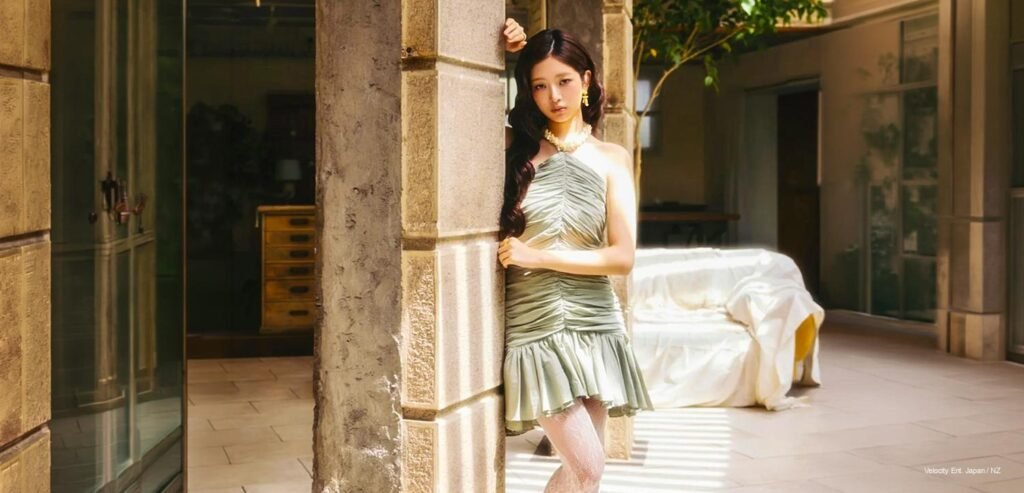
She moves between worlds — Korean pop, Japanese fashion, and global digital culture — like she was built for all three at once. IVE’s Rei is not arriving. She is already here.
The room doesn’t shift when she enters. It reorganises. At the Valentino Spring/Summer 2026 show in Paris, IVE’s Rei sat front row in a Firefly blouse, ivory bows catching the light at the exact angle that makes a photograph feel inevitable. The cameras found her before she moved. That’s the thing about Rei — presence isn’t something she performs. It’s something she radiates at a frequency the room already knows.
It’s May 2026, and the K-pop conversation has been running on IVE’s clock for months. The group’s second full-length studio album REVIVE+ landed February 23rd like a statement of intent — not just sonically but structurally. Dual title tracks. Six solo spotlights. A listening party in LA’s Vinyl Room where the members sat with fans in dim light and just listened. Together.
That image alone said something about where IVE is right now: beyond the hunger of debut, past the pressure of the sophomore slump, operating from a place of earned authority.
For Rei, REVIVE+ delivered something specific: a co-writing credit and a solo track built entirely in her own image. “In Your Heart” moves with the soft-bright logic of a Saturday afternoon in Tokyo — dokidoki energy, Korean warmth, a chorus that codes instantly across cultures because it was written from the inside of all of them simultaneously. The trilingual structure isn’t a marketing decision. It’s just who she is.
“I wanted to show my own personal style and color to the fans — something that was really mine.” — Rei, on writing “In Your Heart” for REVIVE+
Evolution
Born in Osaka, raised between Japanese pop culture and the exacting discipline of Korean idol training, Rei debuted with IVE in December 2021 as the group’s youngest member — a fact that feels increasingly incongruous with the composed, architecturally precise figure she cuts in 2026. The word “growth” gets thrown at fourth-gen artists like wallpaper paste, but with Rei it means something precise: a sharpening of instinct rather than a departure from self.
The turning points were quieter than the milestones suggested. Tokyo Dome in 2024 — nearly 96,000 spectators over two nights — was a homecoming as much as a conquest. Japan’s largest fashion festival, Tokyo Girls Collection. Summer Sonic. Each appearance in her birth country arrived not as a debut but as a confirmation: she had already been there, in the imagination of an audience that recognized its own aesthetic language in her.
Then came the SPU R May 2025 cover — Japan’s prestige fashion magazine — and something clicked into cultural focus. In a wide-brimmed feathered hat and a long floral-print dress, Rei wasn’t performing elegance for a lens. She was editing it in real time.
Fashion as Identity
In the fashion system, K-pop idols have moved from campaign face to cultural collaborator — from the brand choosing them to something closer to genuine co-authorship. Rei’s trajectory inside that shift is worth watching closely. Maison Valentino. Versace whispers. And now Miseki Seoul’s Spring/Summer 2026 season, for which she serves as ambassador — a pairing rooted not in demographics but in shared grammar: the brand’s “Japanese-infused minimalism” and Rei’s own way of carrying clothing like punctuation rather than decoration.
The Miseki Seoul pictorial released this March captures something specific to Rei’s fashion identity: monotone-based styling rendered in unbalanced proportions, the kind of deliberate asymmetry that only reads as intentional when worn by someone who understands it from the inside. Her “soft and sophisticated charm” — the phrase every editor reaches for — understates the technical precision underneath. She doesn’t wear clothes. She edits them.
“It ain’t the brand, it’s all about style. Look at my dress — but focus on me.” — IVE, “Fashion” (2026)
IVE’s April 2026 single “Fashion” is practically a manifesto for the era Rei embodies: style as self-sovereignty, not status signalling. The bilingual track’s core thesis — it ain’t the brand it’s all about style — is exactly the argument Rei has been making through her wardrobe since before it was a lyric. Her off-duty aesthetic carries the same logic: polka-dot blouses layered over skirts, utility sportswear that reads playful rather than casual, the “Pucca buns” that spawned a fan-led trend cycle before any stylist took credit for it.
Creative Direction
What makes Rei interesting as a creative subject in 2026 is the consistency of vision across mediums. The same instinct that shapes her fashion choices — restrained, precise, slightly unexpected — governs how she approaches music. “In Your Heart” is co-written by Rei herself, and its architecture reflects her sensibility: dreamy in temperature, exact in execution, built around a hook that lands simultaneously in three languages without losing momentum in any of them. It evokes Japanese anime warmth without pastiche, K-pop polish without formula.
Her performance approach carries the same signature. In IVE’s group choreography, Rei has always occupied a specific role — the line that gives the formation its visual geometry. Her rap delivery in tracks like “Baddie” holds shape under speed. Her ad-libs in “HEYA” add texture without noise. These aren’t supporting functions. They’re load-bearing.
Solo tracks match the member’s individual persona — and Rei’s ‘In Your Heart’ is a lovely surprise for evoking Japanese anime senses.” — REVIVE+ critical response, February 2026
The REVIVE+ era has amplified IVE’s individual identities without fracturing the group’s coherence — a genuinely difficult creative problem that most fourth-gen acts either sidestep or botch. For Rei, the solo moment isn’t a departure from IVE. It’s the clearest signal yet of what she brings to it.
Fandom & Cultural Energy
DIVE — IVE’s global fandom — has developed a particular fluency around Rei that maps her cultural coordinates with unusual accuracy. The fan edit ecosystem builds parallel archives: the Valentino strut next to the Miseki Seoul spread next to a candid in Guam, a breezy polka-dot moment that circulated through fashion accounts before anyone filed it under “K-pop.” The #ReiMiseki trend cycle on X ran organically, fan-generated, across time zones — Seoul to Auckland to Tokyo to London — in under twelve hours.
That borderless momentum is partly structural — IVE’s second world tour, Show What I Am, has mapped the infrastructure — but it’s also personal. Rei’s NZ-Japan heritage gives her a geographic presence in the conversation that feels lived-in rather than marketed. In Auckland and Tokyo simultaneously, she’s not a bridge between cultures. She’s proof the bridge was always unnecessary.
Present Tense
The IVE ON behind-the-scenes content series dropped a Rei-focused Miseki Seoul episode this week — an intimate, unguarded window into how she inhabits the professional space between idol and creative collaborator. It’s the kind of content that doesn’t announce itself as important. It just is. Thirty minutes of Rei being fully present in a moment, and DIVE watching with the careful attention of people who understand they’re seeing something real.
In K-pop’s current evolution — where the pressure is toward global palatability, algorithmic performance, and perpetual comeback cycles — Rei represents a different kind of velocity. She moves with intention, not urgency. At every front row, every cover, every co-writing credit, the story she’s telling compounds: I am not fitting myself to the frame. I am the frame.
The frequency has already shifted. The room has already reorganised. You’ve been in her heart since before you knew it.
こちらからフィードバックがありますか?こちらからお知らせください。日本語でも大丈夫です。
피드백이 있으신가요? 여기에서 알려주세요. 한국어도 가능합니다.
Kpoppie Magazine
Cover Story: IVE Rei — “The Frequency Shift”
Published by Velocity Entertainment Inc.
Japan · New Zealand
Photo Credits: Deling Magazine, Starship Entertainment
All content © 2026 Velocity Entertainment Inc.
Reproduction in part or full requires written permission.
kpoppie.com