

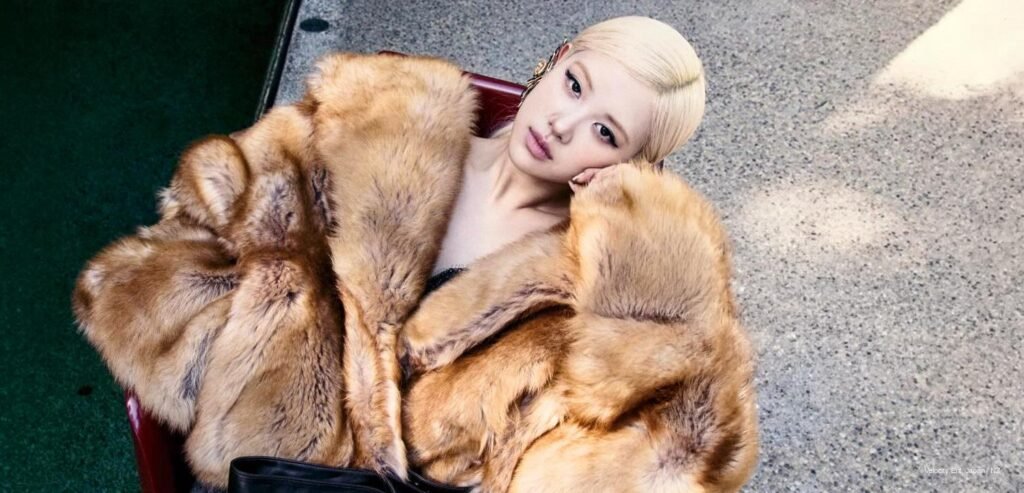
Rosé’s latest Vogue Korea x YSL cover reads like a mood board for the modern K-pop era: elegant, slightly dangerous, and impossible to ignore. It captures the same magnetic push-and-pull that has made her one of pop’s most compelling figures, balancing vulnerability, precision, and pure star power.
The face of a new era
BLACKPINK’s rise has always been bigger than a comeback cycle. Since debuting in 2016, the group has turned performance, branding, and visual identity into a global language, with each member shaping a distinct lane inside a shared universe.
Rosé’s lane is the most ethereal of the four, but it is also one of the most influential: a place where emotion, luxury, and restraint meet.
Her path from trainee discipline to global recognition mirrors the larger K-pop story, but the reason she resonates so deeply is not just momentum — it is consistency.
Rosé has built a persona that feels lived-in rather than manufactured, and that is rare in an industry built on spectacle. She does not perform fashion as decoration; she uses it as character development.
The Meaning of the Moment
A Vogue Korea cover is never just a cover in K-pop. It is a cultural signal, the kind of image that travels across fan accounts, fashion pages, and brand feeds within minutes.
Rosé fronting a Saint Laurent-linked editorial reinforces how fully she occupies the space between pop idol and fashion insider.
The images themselves lean into that duality: one frame is warm, cinematic, and softly decadent; another strips everything down to black-and-white tension, letting posture and gaze do the talking.
Together, they tell a story about reinvention without abandoning identity, which is exactly why Rosé remains so visually persuasive.
Where Style Becomes Voice
Rosé’s style has always felt like an extension of her voice: precise, airy, and just a little haunted in the best possible way. In this editorial universe, fur, lace, sharp tailoring, and minimalist poses become more than wardrobe choices — they become emotional cues.
That is the magic of K-pop fashion when it works at a high level: it does not simply show clothing, it narrates mood.
YSL has been a particularly natural fit because the house’s sleek sensuality complements Rosé’s delicate but assured energy.
She can wear maximal texture or severe monochrome and still look like herself, which is why her fashion presence feels durable rather than seasonal. In a crowded luxury landscape, that kind of identity is the real status symbol.
Creative direction that lands
What makes Rosé stand out inside BLACKPINK is how clearly her artistic choices connect. Her musical tone, stage presence, and visual styling all point in the same direction: understated on the surface, emotionally loaded underneath. That coherence is part of why she works so well in editorial settings, where a single frame has to carry a whole narrative.
BLACKPINK itself helped rewrite the playbook for what a girl group can be in the streaming era. The quartet’s global impact is rooted in contrast — Jisoo’s poise, Jennie’s edge, Lisa’s kinetic energy, Rosé’s atmospheric melancholy — and that contrast gives the group its depth. Rosé’s covers, solos, and fashion moments do not pull her away from the group; they expand the mythology around it.
Fans drive the culture
Rosé’s audience is not passive. Fans do not just consume her images; they circulate them, caption them, remix them, and turn them into shorthand for taste. That matters because K-pop fandom now functions as a real-time media engine, and a fashion cover can become an event before the print edition even lands.
This is where Rosé’s appeal widens beyond fandom into culture. She is the kind of artist whose photos inspire outfit references, beauty trends, and mood boards across platforms, while her name continues to perform at the intersection of music, luxury, and internet-native storytelling. In other words, she is not only being watched — she is being used as a visual language by the people who watch her.
The BLACKPINK effect
BLACKPINK changed the scale of idol stardom by making every member a standalone brand without weakening the group identity. Rosé’s public image has been central to that shift because she embodies a type of modern femininity that feels both globally legible and emotionally specific. She looks like a luxury campaign, but she speaks like an artist.
That balance is what makes her so powerful in 2026’s pop landscape. The industry now rewards stars who can move between sound, fashion, and social media without losing cohesion, and Rosé does that with almost unnerving ease. Her cover work is not a side quest; it is part of the main narrative.
Cover-story close
Rosé’s Vogue Korea x YSL moment is more than a seasonal image drop. It is a snapshot of where K-pop lives now: in the overlap between music and meaning, glamour and authorship, fandom and fashion authority. If BLACKPINK defined one version of global pop, Rosé is helping define the next one.
こちらからフィードバックがありますか?こちらからお知らせください。日本語でも大丈夫です。
피드백이 있으신가요? 여기에서 알려주세요. 한국어도 가능합니다.
Credits & Rights
Credits: Vogue Korea, Saint Laurent / YSL, and all image rights remain with the original rights holders. Editorial concept and published presentation by Kpoppie Magazine in collaboration with Velocity Entertainment Inc Japan / New Zealand.