

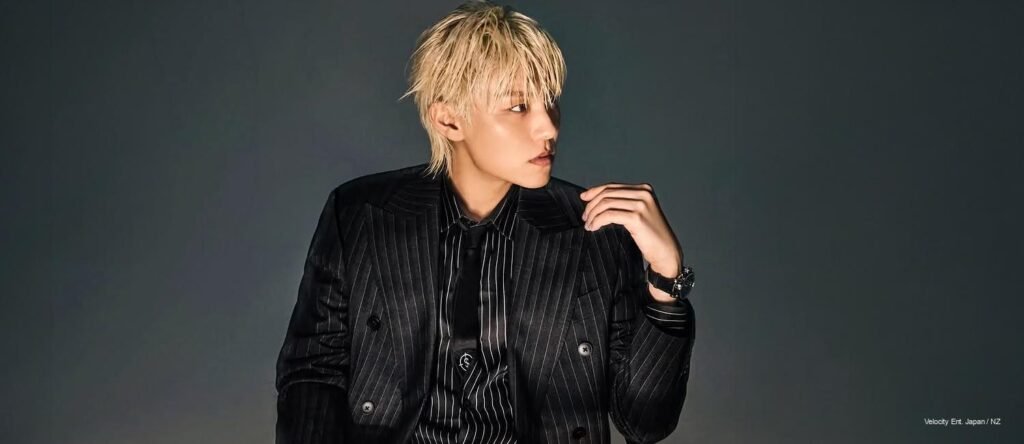
The Cover
Ten individual covers. One unified story. For the June 2026 digital edition, ELLE Korea does something that feels less like a magazine feature and more like a cultural event: it hands the cover — all ten versions of it — to Wanna One. Nine members, nine portraits, one group shot. All in monochrome. All in suits. All unmistakably, undeniably them.
The effect is not nostalgia. It is arrival.
Spring Breeze, Seven Years Later
Picture this: a rainy Monday morning in Seoul. Five to twenty millimetres of rain predicted. And still, they came — hundreds of Wannables who had camped overnight at DMC Cultural Park in Sangam-dong, refusing to let weather stand between them and a moment seven years in the making.
When nine of the eleven members of Wanna One stepped onto that stage on April 6th, dressed in grey uniforms that echoed their Produce 101 Season 2 days, the crowd did not just cheer. It screamed with the kind of sound that carries years of waiting inside it. Two lifesize cutouts stood in for Kang Daniel — currently in mandatory military service — and Lai Kuan-lin, absent due to scheduling conflicts.
But the presence of the nine who were there filled every centimetre of that stage, and every corner of the internet within hours. This is where Wanna One are in 2026: back in the centre of the frame, and refusing to make it feel small.
“I’ve never forgotten about Wanna One once up until now. I wanted to make sure to communicate this.” — Hwang Minhyun
“I’ve Never Forgotten About Wanna One Once Up Until Now”
What separates Wanna One from the long parade of K-pop reunion narratives is the specificity of their feeling. These are not men performing sentiment for a camera.
When Hwang Minhyun says he never forgot, you believe him — because the evidence was always there in the way he spoke about the group in solo interviews across seven years of distance.
When Ha Sung-woon says he feels most alive when they’re together, it lands because his solo career has been meticulously built, genuinely successful, and yet still — still — there is something that only unlocks in this configuration of people.
The June ELLE D edition captures that unlocking. Shot in sleek black and white with minimal styling — no layered accessories, no maximalist fashion editorial noise — the visual language of the shoot is a deliberate act of reduction. Strip everything away and what remains? Presence. The specific gravity of men who grew up, grew into themselves, and chose to return anyway.
“I feel the happiest and the most alive when we’re together. I wanted to relive that feeling and energy.” — Ha Sung-woon
The Architecture of a Legend
To understand the weight of this moment, you need to understand what Wanna One actually was in 2017. They were not a group that slowly built a fanbase. They were a phenomenon that arrived fully formed, preceded by twelve weeks of national obsession through Produce 101 Season 2, the survival show that had the entire country voting on eleven strangers who would share a stage.
Their debut showcase sold out the Gocheok Sky Dome — South Korea’s largest indoor arena. Their debut album moved a million copies. Within months, they swept grand prize honours at every major K-pop award ceremony.
For sixteen months, Wanna One was not just popular; they were the temperature of Korean pop culture.
Then, on schedule, they ended. Their contract expired. The project group dissolved. And eleven individuals — Kang Daniel, Park Ji-hoon, Lee Dae-hwi, Kim Jae-hwan, Ong Seong-wu, Park Woo-jin, Ha Sung-woon, Yoon Ji-sung, Hwang Min-hyun, Bae Jin-young, and Lai Kuan-lin — stepped back into solo careers that would, in the years that followed, span solo discographies, acting careers, film roles, and military service.
Park Ji-hoon recently starred in The King’s Warden, the kind of megahit film that reframes a performer’s entire cultural standing. Ong Seong-wu built a reputation as one of K-pop’s most visually magnetic soloists.
Hwang Min-hyun sustained a fanbase that never wavered. Each member, in their own lane, proved that Wanna One had not just launched careers — it had shaped artists.
Monochrome as Manifesto
The decision to shoot the ELLE feature in black and white is not aesthetic minimalism for its own sake. It is a statement about where these men stand in 2026: beyond trend cycles, beyond the colour-coded merch-era branding of first-generation idol aesthetics. Monochrome, in this context, is confidence. It says: we don’t need the visual noise. Look at us.
The suits — sharp, fitted, quietly luxurious — do the same work. K-pop fashion has, over the past decade, evolved from stage costume to genuine fashion industry force. The genre now commands front rows at Paris Fashion Week, anchors major brand ambassador deals, and shapes global streetwear cycles. Wanna One’s ELLE shoot doesn’t chase that conversation. It operates above it.
Where younger idol groups perform fashion as aspiration — wearing the brand, embodying the campaign — Wanna One wear their suits the way men wear something they chose. The editorial authority isn’t borrowed. It’s earned.
“Wanna One was one of the proudest things of my life. I promised myself that if I ever went back, I would make sure to cherish that moment.” — Park Woo-jin
We Wanna Go: Music as Memory and Forward Motion
The reunion hasn’t been purely nostalgic in its sonic register either. Alongside the Mnet reality program Wanna One Go: Back to Base — which premiered
April 28th to an audience that had been waiting nearly a decade — the group released the OST track ‘We Wanna Go,’ a piece of new music that signals something important: this is not a museum exhibition of old material. It is a live, working creative entity choosing to exist again on its own terms.
The reality show itself is structured around return and rediscovery. The members, each now established in solo careers with their own creative identities, reassemble not as the nervous twenty-somethings who were selected by public vote, but as artists who know exactly who they are.
The chemistry that made audiences vote for them in the first place hasn’t dimmed — if anything, the ELLE BTS footage and the opening ceremony confirmed it has deepened into something more textured, more real.
Yoon Ji-sung, the group’s eldest, left a heartfelt comment on ELLE’s social media post of the shoot footage — a small act that somehow said everything about the emotional temperature of this reunion. He didn’t hold it at arm’s length. None of them did.
“I want to tell Wannables that I’m thankful and sorry for the wait. I hope that you can remember that once Wannables get together, then Wanna One can always come together too.” — Yoon Ji-sung
The Fandom That Never Stood Down
Here is something that K-pop’s global expansion has made structurally possible in a way that would have been unimaginable twenty years ago: a fanbase that does not dissolve when a group disbands. Wannables — the dedicated fandom that organised, voted, sustained, and kept the flame — function in 2026 less like a traditional fan community and more like a distributed creative infrastructure.
They maintained fan cafes, streaming counts, anniversary projects, and social presence across seven years of no official group activity. They showed up in the rain for a 10am fan event on a Monday morning. They crashed the ELLE Korea Instagram post within hours of the shoot reveal. They have, in a very real sense, been ready for this moment since January 2019.
The relationship between Wanna One and Wannables is one of K-pop’s most interesting case studies in parasocial architecture — a connection so specific and so durably maintained that it challenges the industry assumption that project groups are inherently temporary in their cultural impact.
Wanna One were designed to be temporary. Instead, they became permanent in the way that actually matters: in memory, in meaning, in the loyalty of a fanbase that built its own infrastructure of devotion.
What It Means Right Now
We are in a moment in K-pop’s global trajectory where reunion culture has become its own genre. 2NE1 returned. BTS completed military service and came back. I.O.I is preparing for a 10th-anniversary tour. The nostalgia economy is real, and it is powerful, and there is a cynical way to read every one of these returns.
Wanna One resist that reading, not by dismissing it, but by the specificity of their feeling. Lee Dae-hwi says he doesn’t want this moment to become just a memory — that Wanna One will always be a work in progress. That is not nostalgia. That is an argument for the present tense.
Park Ji-hoon puts it cleanly: being with the members makes him more free.
There is a comfort in people who have known you since before you knew yourself. And there is something genuinely moving about eleven people — nine in the room, two in spirit — choosing to locate that freedom again, for the cameras and for themselves, in a monochrome fashion shoot for a magazine that understands exactly what it has in front of it.
Wanna One on the ELLE Korea June cover is not a look back. It is a statement about what endures. And in the current landscape of K-pop — louder, faster, more globally distributed than ever — what endures is not the algorithm. It is the bond.
Bae Jin-young, perhaps most precisely of all, says: “Reuniting with the members, I can feel myself growing again. There’s no time more precious than this.”
There it is. Not a reunion. A reopening.
The full interview and pictorial are available in the June D edition issue of ELLE Korea.
Behind-the-scenes moments from the photoshoot were featured in the May 26 broadcast of Wanna One Go: Back to Base.
ELLE Korea — June 2026 Digital Edition Photography: ELLE Korea Studio | Styling: ELLE Korea Fashion Team | Interview: ELLE Korea Editorial
こちらからフィードバックがありますか?こちらからお知らせください。日本語でも大丈夫です。
피드백이 있으신가요? 여기에서 알려주세요. 한국어도 가능합니다.
Credits & Rights
Publication: ELLE Korea — June 2026 Digital Edition
Issue Type: D Edition (Digital Cover)
Cover Subjects: Wanna One (Park Ji-hoon, Lee Dae-hwi, Kim Jae-hwan, Ong Seong-wu, Park Woo-jin, Ha Sung-woon, Yoon Ji-sung, Hwang Min-hyun, Bae Jin-young)
Absent Members: Kang Daniel (mandatory military service), Lai Kuan-lin (scheduling conflict)
Total Covers: 10 versions (9 individual + 1 group)
Photoshoot Announcement: ELLE Korea official social media, May 16, 2026
Cover Reveal: May 22, 2026
Issue Release Date: June 2, 2026
Photography: ELLE Korea Studio (as credited in publication)
Fashion/Styling Direction: ELLE Korea Fashion Team (as credited in publication)
Creative Direction: ELLE Korea Editorial (as credited in publication)
Interview: ELLE Korea Editorial Team
Music/Entertainment Context:
Reality Program: Wanna One Go: Back to Base — Mnet Plus, premiering April 28, 2026
OST: ‘We Wanna Go’ — released May 2026
Fan Event: April 6, 2026 — DMC Cultural Park, Sangam-dong, Seoul
Original Group Formation: Produce 101 Season 2, Mnet/CJ ENM, 2017
Original Labels: YMC Entertainment / Stone Music Entertainment / Swing Entertainment
Group Active Periods: 2017–2019 (original); 2021 (MAMA special); 2026 (reunion)
Feature Article: Written for editorial purposes. All member quotes sourced from ELLE Korea June 2026 D Edition interview. Fan community reactions sourced from theqoo (Korean online community) translations via Pannchoa, May 22, 2026.
Copyright Notice: All photographic content © ELLE Korea / Hearst Korea. All music and entertainment content © respective rights holders.
This Kpoppie editorial feature is produced for journalistic and cultural commentary purposes. Kpoppie Media @ Velocity Entertainment inc New Zealand / Japan
Corrections / Editorial Contact: editorial@kpoppie.com