

Opening Scene
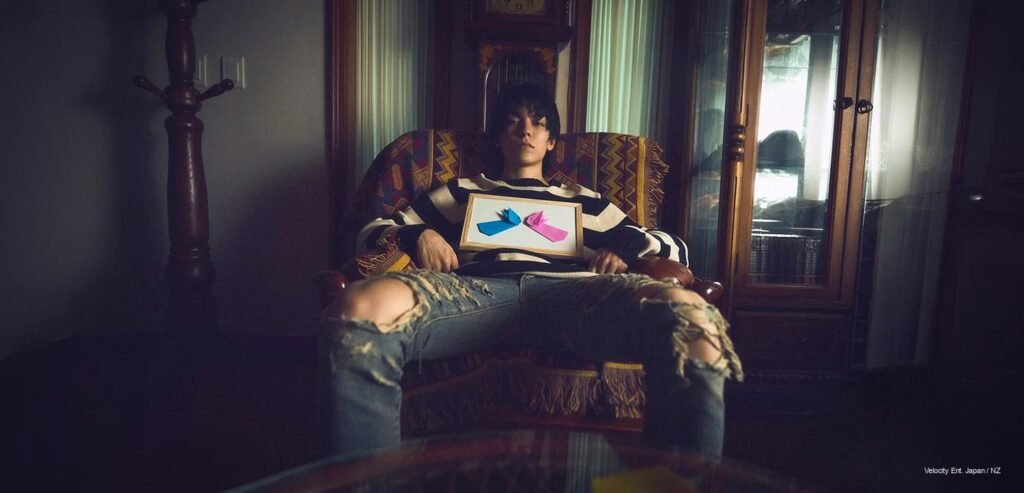
He’s slouched into a chair that looks older than the concept of K-pop itself — dark wood, tapestry upholstery, a grandfather clock ticking somewhere behind his skull like it’s counting down to nothing in particular. Ripped denim. Striped knit. A small wooden frame balanced on his lap, two origami birds inside it — one blue, one pink, caught mid-conversation. He is not smiling. He does not need to.
This is Vernon in GQ Korea’s September 2026 pictorial, and the image does what the best Vernon images have always done: it makes stillness look like the loudest thing in the room. No choreography, no pyrotechnics, no fan chant. Just a boy in a chair who has stopped trying to convince you of anything.
That’s the whole thesis, actually. In a genre engineered for maximalism, Vernon has spent a decade quietly building a case for restraint — and in 2026, restraint is the flex.
The Turn
Vernon entered the industry as the bilingual anomaly — American-born, hip-hop-literate, the member who could rap in two languages and still seem like he wasn’t trying. For years that framing was useful shorthand. It was also, in retrospect, a container too small for what he actually is.
“I’d rather someone feel something weird looking at me than feel nothing looking at something perfect.”
The shift didn’t arrive as a single moment. It arrived as accumulation — a production credit here, a styling risk there, an interview where he stopped performing enthusiasm and started performing precision instead. Somewhere in that accumulation, the “chill member” narrative quietly dissolved.
What replaced it was harder to market and far more interesting: an artist whose entire appeal is that he refuses to be legible on command. That’s not a caption. That’s a worldview.
Fashion as Argument, Not Costume
Look at the tank top, the shaved head, the quiet menace of the second image — nothing about it asks to be liked. It asks to be reckoned with. Vernon’s fashion identity has never chased the glossy idol-boy uniform; it’s closer to a mood board assembled by someone who reads runway the way he reads a verse — for texture, not trend.
The checkerboard knit and red trousers in the third frame push the opposite direction entirely: playful, almost cartoonish, styled with the loose-limbed confidence of someone crouched on his own sketchbook mid-thought. Between the three images, a pattern emerges that has nothing to do with consistency and everything to do with range as identity. Grunge one frame, mischief the next, monk-like stillness in between.
This is what “fashion as a second language” has evolved into across K-pop’s global expansion — not matching outfits signaling group unity, but individual style vocabularies that let each member argue a different point. Vernon’s argument is texture over shine, mood over polish, silence dressed up as attitude.
Creative Direction: Sound, Vision, Synergy
What makes Vernon’s current era land isn’t any single deliverable — it’s the way music, movement, and image now function as one continuous sentence. His production work has grown more architectural, less ornamental; his visual presence has grown more sculptural, less performative. The two have started to mirror each other in a way that feels less like a rebrand and more like a maturing signature.
Where earlier K-pop visual language leaned toward maximal spectacle — every frame fighting for attention — Vernon’s current output does the opposite.
It trusts negative space. It trusts the pause before the punchline. On a platform economy built for the loudest three seconds, that’s a genuinely disruptive choice.
Cultural Impact + Fandom Energy
CARATs have always understood something the wider industry took years to catch up on: Vernon’s magnetism isn’t spectacle-based, it’s frequency-based.
“Everything doesn’t need a hook. Some things just need a feeling that stays.”
He rewards attention rather than demanding it.
Fan edits built around his GQ Korea pictorial aren’t chasing virality through chaos — they’re chasing stillness, slowed frame rates, single held glances stretched into fifteen-second meditations.
That fan instinct mirrors something larger happening across the K-pop ecosystem right now. As the genre’s global footprint widens — reshaping runway casting, streetwear collaborations, and youth aesthetic movements from Seoul to São Paulo — the artists breaking through hardest aren’t always the most polished. They’re the most specific. Vernon’s specificity is his currency, and in 2026’s algorithm-saturated pop landscape, specificity is scarce.
Where He Stands Now
Vernon isn’t chasing a rebrand. He’s finishing a sentence he started years ago, just with better grammar. The idol-as-multi-hyphenate model — rapper, producer, style auteur, quiet cultural signal — used to be aspirational language in press kits. On him, it’s just accurate.
“I don’t need the whole room. I need the right ten seconds.”
What comes next for Vernon looks less like a pivot and more like deepening — further into production, further into a visual language that trusts ambiguity over exposition. In an industry sprinting toward louder, faster, shinier, he’s building his relevance on the opposite bet: that stillness, held long enough, becomes its own kind of spectacle.
The clock behind him in that first image keeps ticking. He, notably, does not.